the art of winning the car deal
NOW available!

As promised in Chapter 6 of The Art of Winning the Car Deal, I’m including this section on invoice pricing. I do want to say: don’t get too distracted by the invoice price, which is supposed to represent the price the dealer paid the manufacturer for a new vehicle on their lot. I showed you how to negotiate a great deal, even though all I needed to know was the MSRP. The sticker price is displayed on a new car's window (by law), so it’s certainly transparent and highly resistant to dealer tampering.
Some dealers will disclose the invoice price if you simply ask. Others will not. Invoice pricing is available on some websites. Simply search for the invoice price of the specific Year, Make, Model, and Trim of the vehicle you’re interested in. You may have to pay a fee for it.
I intentionally placed the invoice price in the middle of the negotiations section of the book because that’s exactly what the sales manager did to me. It was a distraction. That’s why, again, I recommend focusing on negotiating the numbers you see on the deal sheet. Negotiating requires complete focus without including numbers that aren’t even on the deal sheet, and that’s the truth.
With all of these “warnings,” you need to understand that invoice pricing is a completely different animal than MSRP. It’s intentionally not transparent. Some of that is due to car manufacturers and dealers not wanting their competitors to know their internal financials. It’s also just a number. A number that typically has to be further “manipulated” to reach what a specific dealer actually paid the manufacturer for a particular vehicle.
For example, the invoice does recognize the “gross” cost of the vehicle for the dealer. However, it doesn’t include items such as holdback, marketing incentives, special-dealer volume pricing, national sales-event incentives, etc. That’s not intended to be a complete list either, because I don’t own a car dealership, and that should be taken as an “outside looking in” view. Just know that the true dealer cost of a particular vehicle will be difficult for an outsider to calculate, by design.
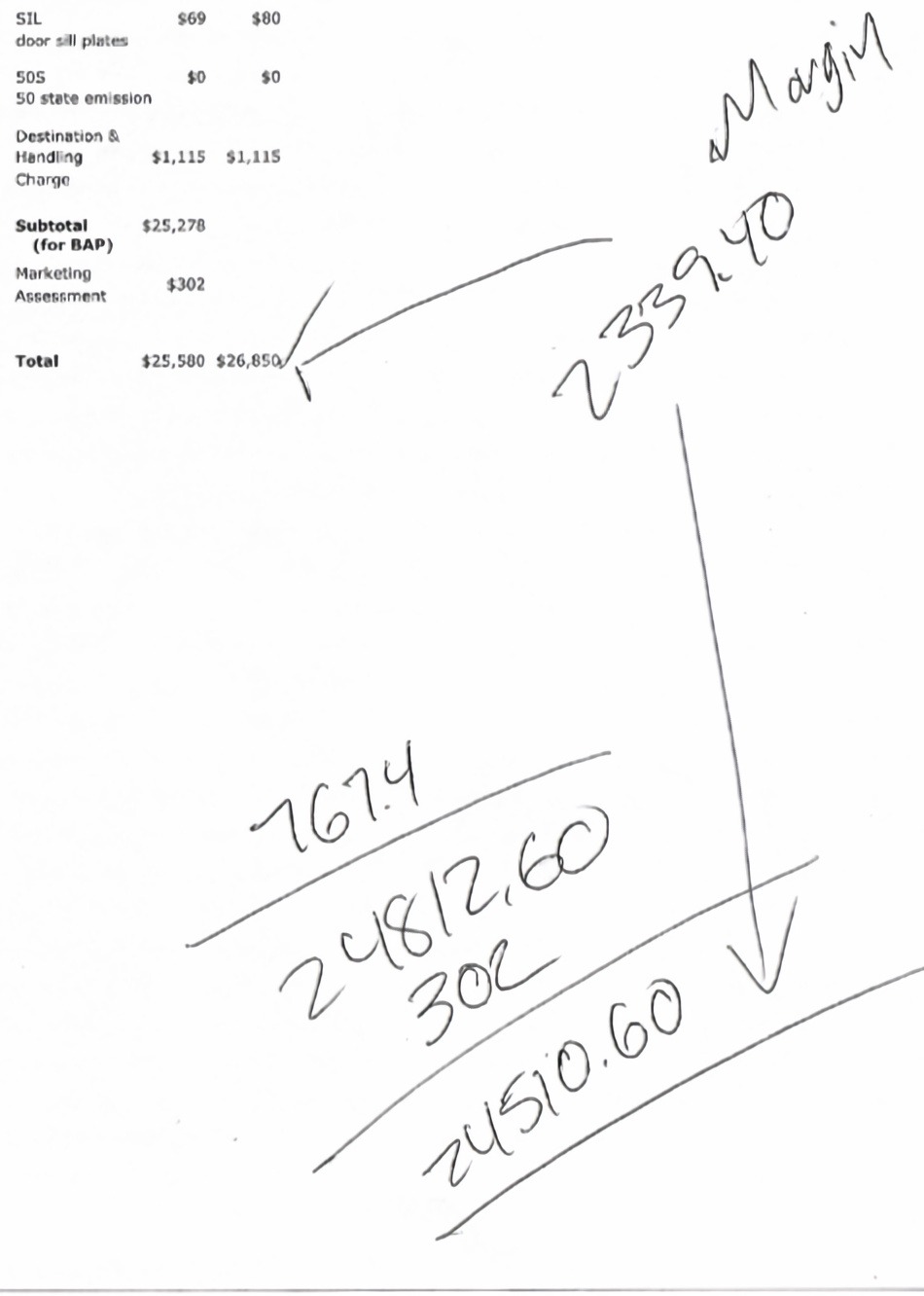
Now, let's examine the dealer's “printed invoice price” for the 2024 Sentra we purchased. Our sales manager "accidentally" brought the car's invoice sheet to the negotiating table, and I snapped a quick pic. I did that more to evaluate the deal we actually got after we were home, rather than getting bogged down over it during the negotiations. I didn’t negotiate based on the invoice price. Why would I, since I was getting everything I asked for starting from MSRP?
Manufacturers typically “hold back” 1-3% of an individual car’s price until after the dealer sells the car, at which point that amount is paid, credited, or otherwise given to the dealer. When I mentioned holdback to this sales manager, he immediately said, “It’s 3%.” I feel pretty confident in saying that the % holdback a particular car manufacturer uses is known in the industry, even though it may vary by specific brand (Nissan or Infiniti) and model. So, no secrets divulged here.
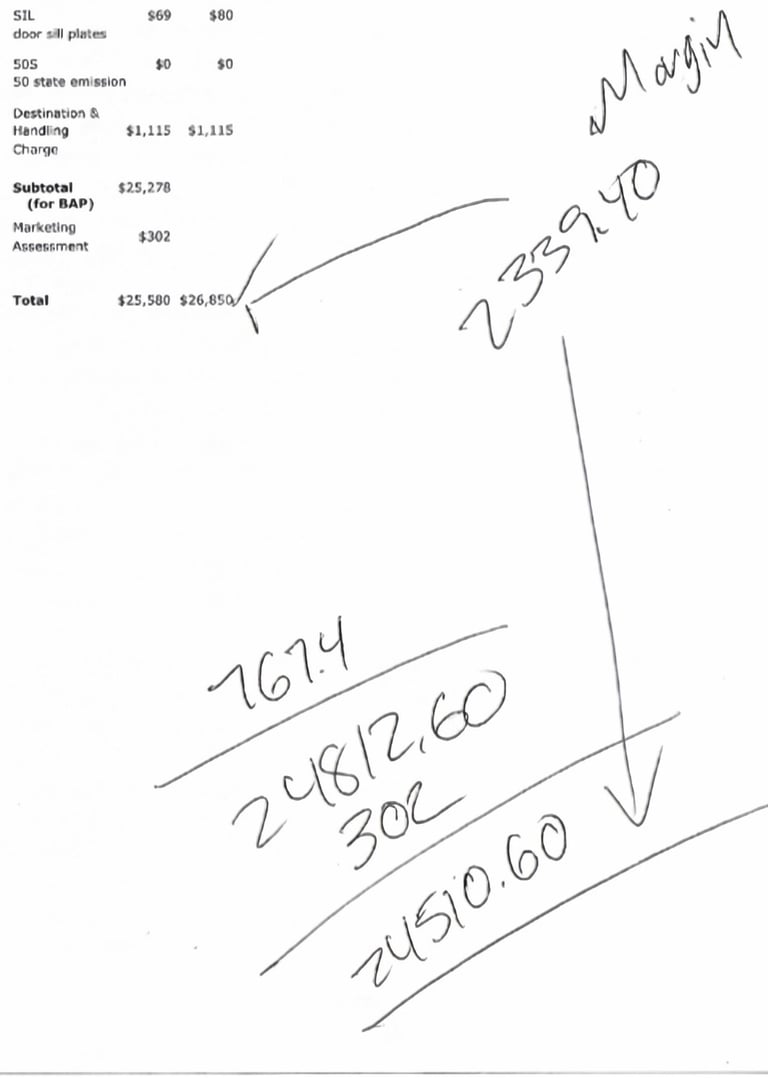
It's time we look at the “magic invoice sheet.” I am more cautious about the confidentiality of everything on the dealer invoice sheet, so I’m only showing a small portion here out of respect. To be perfectly clear, that's not my writing on the invoice sheet. The sales manager wrote those numbers when calculating the Sentra's invoice price, which he determined to be $24,510.60.
That $302 marketing assessment is a genuine dealer expense related to regional advertising, so I don't know why he subtracted it. Again, this is the kind of gray area you might encounter when trying to determine a specific, accurate invoice price as a car buyer, because it isn't prominently displayed on a window sticker.
Given what we know, let’s try to determine the true dealer cost for our vehicle. If 3% of the printed invoice price ($25,580 x 0.03) equals $767.40 for our Sentra SV, then that’s the holdback dollar amount. So, when they sell the car and receive $767.40 from the manufacturer, their invoice price drops from $25,580 to $24,812.60. After subtracting the $302 “marketing assessment” for that specific car, the invoice decreases to $24,510.60.
Once the Accountants are finished, is $24,510.60 the true amount that this dealer paid for this specific car? Maybe, maybe not. And there’s no way I’ll attempt to get deeper in the weeds than what you see here. That would require making assumptions about Nissan's internal finances, which are not intended to be public information.
For now, let’s stick with what we do know: $24,510.60. Assume that is the invoice price of the vehicle I purchased. Subtract that amount from the MSRP to get the “Margin,” which is the profit margin the dealer has to work with before they start to lose money by selling the car. In other words, if I’m a dealer and I pay a car manufacturer $24,510.60 for a car that I later sell for $23,510.60, did I make money on that car? Nope. In fact, I lost $1,000 when I sold it for $23,510.60.
Please don’t take any of these numbers as written in stone. The sales manager already told me that he had “an extra $500 to work with” during the National Black Friday and Cyber Monday Sales Event. There could’ve even been an extra “end of the month” incentive available, too. Plus, we financed at 3.99% through Nissan Finance.
Therefore, interest would be earned on our finance contract initiated at the dealership if we made all the payments as scheduled. (FYI, we took out a 401(k) loan and paid off the Nissan loan in less than 2 weeks. We have the car title, and now the interest we pay goes into our 401(k) savings account instead of being paid to Nissan.) You should speak with your Financial Advisor for the best way to pay for your new vehicle.
After all was said and done, we bought this new Sentra SV for a Selling Price of $23,350, before taxes and fees. That’s a fact. Based on the available numbers, this dealer paid Nissan $24,510.60 for the car. That means when the sales manager told me, “I’m losing money on this deal,” he wasn’t kidding. I paid them $1,160.60 less than they paid for the car.
Of course, $500 of it was a “College Graduate Rebate” directly from Nissan. So, the dealer only lost $660.60 on this sale. If you add the $302 marketing assessment back to the dealer cost of this vehicle, then I paid $1,462.60 less than the invoice price. This is why dealers use add-on fees, including the dealer doc fee, to increase their profit on profitable deals and help offset small losses on some deals.
It's your choice whether to include the invoice price in your negotiations. I used MSRP as my starting point, and ended up paying less than the true dealer cost. Things can move quickly, and numbers often need to be recalculated rapidly in negotiations. I appreciate the simplicity of focusing on eliminating useless add-on charges, maximizing my discount off MSRP, getting the highest trade-in value, and reducing Sales Tax liability.
Invoice Pricing
info@pileobenjamins.com
© 2025-2026, Pile O. Benjamins, LLC
All rights reserved.